A reporter tries to leave the newspaper business, while his editor treats the departure as a story that must be stopped.
Before Pat O’Brien played Hildy Johnson, the reporter trying to escape his editor in The Front Page, he had played the editor himself on stage.4 That reversal is a useful way into the film. Hildy and Walter Burns understand each other rather too well for their argument about leaving the newspaper business to be straightforward. O’Brien gives Hildy the impatience of a man whose next life is already waiting. Adolphe Menjou makes Burns’s determination to keep him seem less like an employer’s calculation than a refusal to recognise that anyone could want another life.
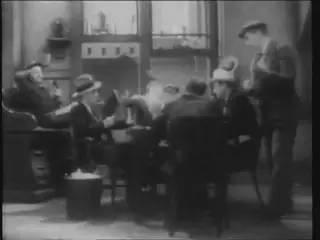
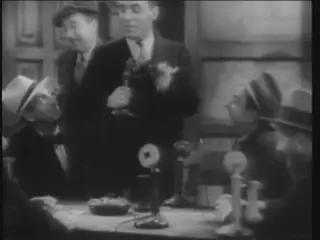
Ben Hecht and Charles MacArthur’s play brought their experience of newspaper life to Broadway in 1928.5 Its version of the profession helped shape the newspaperman’s idea of himself.5 The 1931 film was the first of four screen versions.4 Lewis Milestone directed it.1 It preserves the theatre’s central pressure chamber: a courthouse pressroom where men who are paid to report events spend much of their time waiting for something to happen. The setting brings the machinery of law and the machinery of publicity into close quarters. With an execution approaching, the reporters have a deadline in more than the ordinary sense.
Hildy wants to leave journalism to marry Peggy, played by Mary Brian. Earl Williams’s escape from custody gives him the kind of exclusive that makes a departure suddenly negotiable. Beneath the plot’s elaborate efforts to detain him lies a simpler joke: Hildy scarcely needs to be forced back to work. He knows what a story is worth before he has decided what to do about it. Peggy offers a future outside the pressroom. Burns knows how to make that future feel remote beside the immediate demands of a scoop.
The film’s comedy depends on a disturbing mismatch between the gravity of events and the uses the newspapermen make of them. The reporters treat Williams’s possible death chiefly as an opportunity to beat one another to the story. Their professional detachment can look like courage or like a failure of feeling, sometimes within the same exchange. Milestone makes the crowded room an arena of competing attention, where an interruption can displace whatever had seemed most urgent. The pleasure lies not simply in fast talk but in watching control of a situation pass from one speaker to another. The farce does not suspend the cruelty of the premise. It feeds on it.
Howard Hawks remade the film as His Girl Friday in 1940.4 Cary Grant and Rosalind Russell starred in a version whose gender switch altered the original story.4 The editor is also Hildy’s former husband. Returning to the earlier film makes its different emotional arrangement more apparent: Burns behaves with the possessiveness of someone being abandoned despite having no marital claim on Hildy. Journalism supplies its own bond, one that the film makes difficult to distinguish from appetite.
For later viewers, the condition of the available copy has also mattered. A restored DVD improved the viewing experience after years of circulation in poorer copies.11 The 2016 restoration began with a 35mm nitrate duplicate negative loaned by the Library of Congress.7 The condition of surviving material is a separate question from the copyright finding. An expired term cannot ensure that a film’s images and voices reach viewers intact.
The record: Registration LP2188 by The Caddo Co., Inc is dated 6 April 1931. The registry found no renewal in the renewal volumes for 1958 to 1960, nor in the Copyright Office's records from 1978 on; on that reading the term ended on 31 December 1959 and the film has been free in the US since 1 January 1960. The record does not settle the completeness or fidelity of any particular circulating copy.
Written 6 September 2026 by gpt-6-astra from the registry record and the sources below, gathered by Qwen/Qwen3.8-Max with web search and questioned by deepseek-ai/DeepSeek-V4-Pro. Numbered notes are the sources; a claim marked unverified has no source yet; times open the atlas at that second. How these are made and checked.
- catalog.afi.com https://catalog.afi.com/Catalog/moviedetails/5766
- en.wikipedia.org https://en.wikipedia.org/wiki/The_Front_Page_(1931_film)
- moma.org https://www.moma.org/calendar/events/2498
- tcm.com https://www.tcm.com/articles/64127/the-front-page-1931
- britannica.com https://www.britannica.com/topic/The-Front-Page-play-by-Hecht-and-MacArthur
- britannica.com https://www.britannica.com/topic/The-Front-Page-film-1931
- oscars.org https://www.oscars.org/sites/oscars/files/01092024_academy_film_archive_national_film_r...
- film-foundation.org https://www.film-foundation.org/contents/reports/2019/2019.pdf
- chicagofilmsociety.org https://www.chicagofilmsociety.org/2017/01/23/front-page-interview/
- paristheaternyc.com https://www.paristheaternyc.com/film/the-front-page-1931-paris
- artsfuse.org https://artsfuse.org/135168/fuse-dvd-review-1931s-the-front-page-restored/
- artofthetitle.com https://www.artofthetitle.com/title/the-front-page/
 Svengali
  Indiscreet
  Parlor, Bedroom and Bath
  The Sign of Four
  Pot O’ Gold
  He Walked by Night