A secluded farm becomes a place of confinement in Delmer Daves’s story of an adopted daughter and the secret her guardian cannot release.
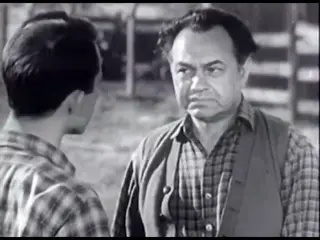
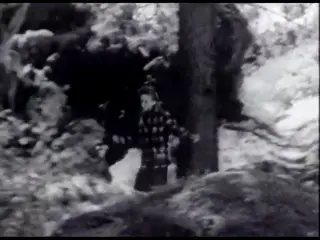
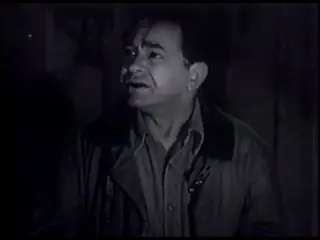
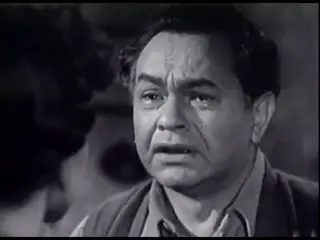
The terror in The Red House comes from a man who wants to keep his household together. Pete Morgan, played by Edward G. Robinson, lives on a secluded farm with his sister Ellen and their adopted daughter Meg.1 His care for Meg takes the form of control over what she knows. Beyond the working farm lies an abandoned house in the woods, a place he forbids the young people to approach.1 The story makes protection and possession difficult to separate: the person offering shelter is also the person deciding where its inhabitants may go.
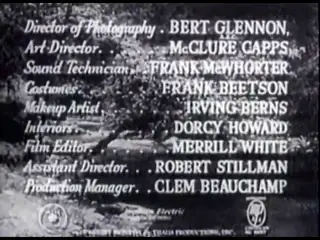
Delmer Daves adapted the screenplay from George Agnew Chamberlain’s novel The Red House.1 Sol Lesser produced the film.1 It was released through United Artists.1 Principal photography took place in the spring of 1946, largely in Sonora, California.1 That rural setting is more than a retreat from the city. Pete’s prohibition places a boundary across the practical world of the farm, where daily work depends on access to the land. The woods become dangerous partly because he insists that they are, making an ordinary journey an act of disobedience.
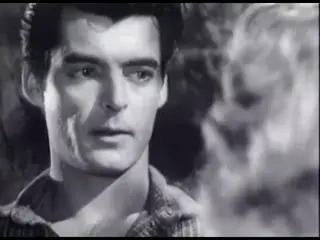
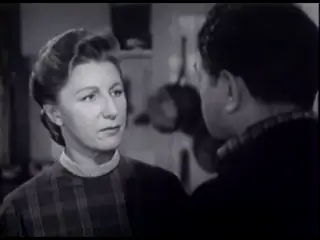
The arrival of Nath Storm, a young neighbour hired to help on the farm, gives Meg a companion whose loyalties have not been formed entirely within the Morgan household.1 Nath can question a rule that Meg has grown up accepting. Ellen’s position is different, since she knows more than either young person.1 The mystery therefore concerns how knowledge is distributed among people who share meals and work. Pete’s authority depends on keeping those unequal shares intact.
The uncertainty extends to the kind of film this is. “Ghost Noir” is one critical description of its rural mountain mystery.11 The term carries the expectation of concealed wrongdoing into a landscape far from the streets usually associated with noir. The threat of the house gives a shape to things the family cannot discuss. In a review published on 17 March 1947, the New York Times critic signing as A.W. remarked on how long it had been since Hollywood produced an “adult horror number” like this one.9 The useful word is “adult”: the central danger belongs to the guardians, not to the young people testing their warnings.
Miklós Rózsa’s music gives that concealed life another means of expression. He sought out the theremin player Dr. Samuel Hoffman for the score.6 The instrument places an unfamiliar sound within a story of recognisable domestic relationships. Its distance from an ordinary human voice suits a household in which what cannot be said governs what can be heard. Music also became a separate route back to the film through a 2012 recording of the complete score, conducted by Allan Wilson.14
The film’s later availability has taken several forms. It can be viewed and downloaded freely from the Internet Archive.12 Film Masters has also released a Blu-ray edition.15 Neither form of access, by itself, explains the film’s copyright history. A rights statement attached to a Wikimedia Commons image offers missing copyright formalities or renewal as alternative explanations.13 That wording leaves two different possible histories unresolved. The registry gives the more specific account reproduced below. No primary registration or renewal record was verified in the sources gathered for this essay, so those sources do not independently establish the registry’s findings.
The record: Registration LP864 by Thalia Productions, Inc., New York is dated 7 February 1947. The registry found no renewal in the renewal volumes for 1974 to 1976, nor in the Copyright Office's records from 1978 on; on that reading the term ended on 31 December 1975 and the film has been free in the US since 1 January 1976. The record does not settle the separate rights, if any, in the source novel or material added to later editions.
Written 6 September 2026 by gpt-6-astra from the registry record, the atlas's own evidence and the sources below, gathered by Qwen/Qwen3.8-Max with web search and questioned by deepseek-ai/DeepSeek-V4-Pro. Numbered notes are the sources; a claim marked unverified has no source yet; times open the atlas at that second. How these are made and checked.
- en.wikipedia.org https://en.wikipedia.org/wiki/The_Red_House_(film)
- catalog.afi.com https://catalog.afi.com/Film/25313-THE-RED-HOUSE?cxt=filmography
- biblio.com https://www.biblio.com/book/red-house-chamberlain-george-agnew/d/1599785644
- imdb.com https://www.imdb.com/title/tt0039757/fullcredits/
- moviemusicuk.us https://moviemusicuk.us/2024/04/08/the-red-house-miklos-rozsa/
- audaud.com https://www.audaud.com/the-red-house-blu-ray-dvd-2-disc-pack-19472012/
- m.imdb.com https://m.imdb.com/title/tt0039757/
- classicfilmnoir.com https://www.classicfilmnoir.com/2026/08/the-red-house-1947.html
- joancrawfordbest.com http://www.joancrawfordbest.com/londonfilms47to49.htm
- nytimes.com https://www.nytimes.com/1977/08/19/archives/services-tomorrow-for-delmer-l-daves-motion...
- popmatters.com https://www.popmatters.com/red-house-delmer-daves-review
- archive.org http://archive.org/details/the.-red.-house.-1947
- commons.wikimedia.org https://commons.wikimedia.org/wiki/File:The_Red_House_(1947)_1.jpg
- discogs.com https://www.discogs.com/release/8788257-Mikl%C3%B3s-R%C3%B3zsa-Allan-Wilson-2-Royal-Sco...
- dvdbeaver.com http://www.dvdbeaver.com/subsite/best_physical_media_of_2025.htm
 Angel and the Badman
  Dishonored Lady
  Brideless Groom
  Sing a Song of Six Pants
  The Green Glove
  The Stranger
  Detour
 _1.jpg)