Military camp
Machine annotation by Qwen/Qwen3-VL-235B-A22B-Instruct, cut beats-0.2, prompt beats-0.2. Machine checks passed (partial). 2 quotes checked against the transcript; 6 names checked for a spoken or on-screen source; 1 of 4 visible events checked against a frame. Not human-reviewed. Observations and transcript may still be wrong.
Play from 23:14 on the Internet Archive This passage on the film's page
Evidence and details
Starts here: pause in speech. Sequence 72 · shots 301–304. Observations cite a frame (frame:n) or a time (t:m:ss); frames are the sampled ones above.
- Place
- military camp (camp, interior) evidence: frame:1
- People
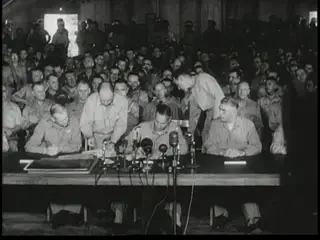
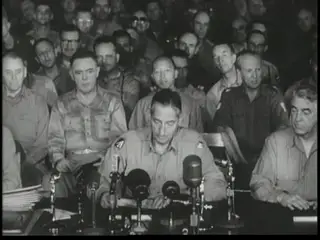
- General Clark (named at t:23:16): man in military uniform, seated at table, signing documents visible
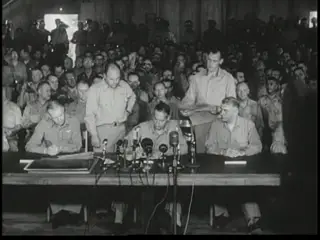
- man in military uniform, standing behind p1, assisting with documents visible
- man in military uniform, seated at table to p1's right visible
- man in military uniform, seated at table to p1's left visible
- soldiers in uniform, seated or standing in background visible
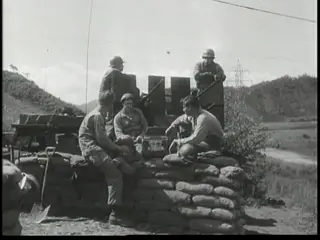
- soldiers in uniform, outdoors near artillery and sandbags visible
- Seen happening
- General Clark signs a document at a table surrounded by military personnel. [frame:1]
- A man stands behind General Clark and hands him a document while others observe. [frame:2]
- General Clark speaks into microphones at the table while seated. [frame:3]
- Soldiers are positioned around artillery pieces in an outdoor field setting. [frame:4]
- Seen
- microphones, documents, table, military uniforms, artillery piece, sandbags, hills
- Interpretation
- Model opinion, not evidence: mood: solemn and restrained; themes: ceasefire signing, military protocol, post-war solemnity; style notes: static medium shots of signing ceremony; wide shot of outdoor military position; black-and-white film with high contrast lighting
General Clark signs ceasefire documents at a UN base camp in Munsan while surrounded by military personnel; later, soldiers are shown at an outdoor artillery position. The transcript states the signing occurred as communists signed at Panmunjom and that the moment calls for prayer rather than celebration.
“While the communists signed at Panmunjom, General Clark, in ceremonies at the UN base camp in Munsan, signed six copies of the document which would end the bloodshed. There was excitement, but little rejoicing.” 23:16 · “to heal. Therefore, I am thankful. The task now is to put the ceasefire agreement into full effect and get down to working out an enduring settlement of the Korean problem. I cannot find it in me to exult in this hour. Rather, it is a time for prayer, that we may succeed in our difficult endeavor to turn this armistice to the advantage of mankind.” 23:46 automatic transcript, may be wrong
The record
US Government work The record names a federal body as the creating agency. A work prepared by an officer or employee of the United States Government as part of that person's official duties has no US copyright (17 U.S.C. 105; before 1978, section 8 of the 1909 Act). This says nothing about copyright outside the United States, or about music, stock footage or other material the film may incorporate. Evidence dossier. The finding concerns the US copyright record for the film; it is not clearance for any use, and this page's annotation is machine output.
Share
Paste the permalink anywhere that shows link previews and it carries the frame, the time and the finding. The card image can be saved and used with a credit.

- Permalink
- always the current cut
- Permalink to this version
- warns if the beats are recut later
- Card image
- https://publicreel.org/cards/moment/gov.dod.dimoc.30120/b124.png
- Figure for a newsletter or page
- Cite