Bar
Machine annotation by Qwen/Qwen3-VL-235B-A22B-Instruct, cut beats-0.2, prompt beats-0.2. Machine checks passed (partial). 4 quotes checked against the transcript; 2 names checked for a spoken or on-screen source; 0 of 2 visible events checked against a frame. Not human-reviewed. Observations and transcript may still be wrong.
Play from 11:34 on the Internet Archive This passage on the film's page
Evidence and details
Starts here: pause in speech; cut falls inside a spoken line: no pause was available without exceeding the length cap. Sequence 11 · shots 60–61. Observations cite a frame (frame:n) or a time (t:m:ss); frames are the sampled ones above.
- Place
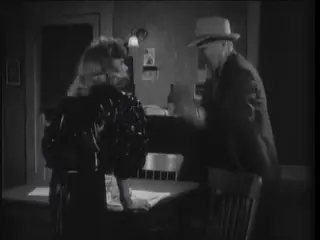
- bar (bar, interior) evidence: frame:1, frame:2, t:11:38
- People
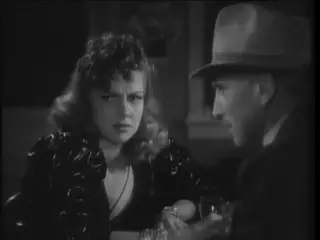
- woman with curly hair, wearing a dark, shiny blouse visible, audible
- man wearing a fedora and dark suit visible, audible
- Seen happening
- A woman and a man are seated at a bar, engaged in a tense conversation. [frame:1]
- The man stands up and gestures while speaking to the woman at the bar. [frame:2]
- Also said
- “Can you prove you didn't do nothing?” 12:02 · “No. He'd go to the chair for you, wouldn't he?” 12:06
- Seen
- whiskey bottle, bar counter, bar stool, fedora hat, dark shiny blouse
- Interpretation
- Model opinion, not evidence: mood: tense and accusatory; themes: moral ambiguity, culpability and guilt, fear of false implication; style notes: tight two-shot framing, high-contrast lighting typical of 1930s noir, minimal set design emphasizing character interaction
A woman and a man in a dimly lit bar argue about culpability after an incident involving someone named Johnny. The dialogue suggests they fear being implicated despite claiming innocence.
“But we didn't do anything. Yeah. Well, we were there, weren't we? You think he's going to say we didn't do anything? You think he's going to take the rap while we walk out? But we didn't do anything. Oh, shut up.” 11:47 · “It ain't that you do anything, it's can you prove it.” 12:00 automatic transcript, may be wrong
The record
No renewal found An automated finding, not a verdict. A renewal would have appeared in the Copyright Office's renewal registrations 27 to 29 years after the term began. Those volumes are loaded and our parse of them found no matching renewal. If that is right, a work published 1931–1963 that was not renewed entered the public domain at the end of its 28th year; the volumes are OCR of old print, and the method page reports how often the parse has been found to miss one. Evidence dossier. The finding concerns the US copyright record for the film; it is not clearance for any use, and this page's annotation is machine output.
Share
Paste the permalink anywhere that shows link previews and it carries the frame, the time and the finding. The card image can be saved and used with a credit.

- Permalink
- always the current cut
- Permalink to this version
- warns if the beats are recut later
- Card image
- https://publicreel.org/cards/moment/They_Made_Me_A_Criminal_1939/b28.png
- Figure for a newsletter or page
- Cite